The commercial and industrial interior design and build industry is entering a period of profound transformation. Across North America, businesses are no longer evaluating facilities solely on aesthetics, operational capacity, or square footage. Instead, organizations are increasingly prioritizing safety, compliance, employee wellbeing, sustainability, and long-term adaptability as core drivers of design strategy.
In 2026, safety and compliance are no longer treated as isolated technical requirements addressed late in construction. They have become foundational pillars that influence every stage of the modern design-build process — from spatial planning and material selection to technology integration, employee experience, ESG strategy, and operational resilience.
The Cost of Non-Compliance Has Never Been Higher
The reason is simple: the cost of non-compliance has never been higher.
Industrial and commercial organizations face growing pressure from evolving building codes, occupational safety standards, accessibility regulations, environmental requirements, energy performance mandates, and corporate ESG commitments. At the same time, workforce expectations are changing rapidly. Employees now expect environments that are not only safe, but also healthy, comfortable, adaptable, and technologically integrated.
As a result, safety and compliance are evolving from reactive obligations into strategic business investments.
According to recent industry research from leading architecture and workplace design publications, modern commercial interiors are increasingly shaped by flexibility, wellness, sustainability, and intelligent planning. Publications from Ware Malcomb, Gensler, Deloitte, and JLL all highlight the growing importance of integrating compliance and human-centered performance into commercial and industrial environments from the beginning of a project lifecycle.
From Static Facilities to Adaptive, Resilient Environments
One of the biggest industry shifts is the move away from static facilities toward adaptive and resilient environments. Traditional industrial layouts were often designed around fixed operational models with little flexibility for future growth or regulatory evolution. Today, however, organizations require spaces capable of adapting quickly to operational changes, workforce demands, and new compliance expectations.
Flexible planning has therefore become one of the most important safety and compliance strategies in modern industrial design.
Modular workstations, scalable electrical systems, adaptable circulation pathways, movable partitions, and multi-functional zones allow facilities to evolve without requiring expensive reconstruction. This flexibility improves operational continuity while helping organizations maintain compliance more efficiently over time.
Safety Itself Is Being Redefined
Historically, workplace safety focused heavily on physical hazards such as machinery, fire protection, fall prevention, and emergency exits. While these remain critical, the modern concept of safety now includes mental health, psychological wellbeing, ergonomic performance, indoor air quality, acoustics, and overall workplace experience.
Industry experts increasingly describe modern workplaces as “human-centric ecosystems” rather than simple operational environments.
This shift is especially visible in industrial and manufacturing facilities where employers are competing aggressively for skilled labor. Facilities that once prioritized only operational throughput are now investing heavily in employee-centered design strategies that support productivity, retention, and wellbeing simultaneously.
Modern safety-oriented interiors increasingly include
- Improved natural lighting
- Acoustic optimization
- Quiet rooms and wellness zones
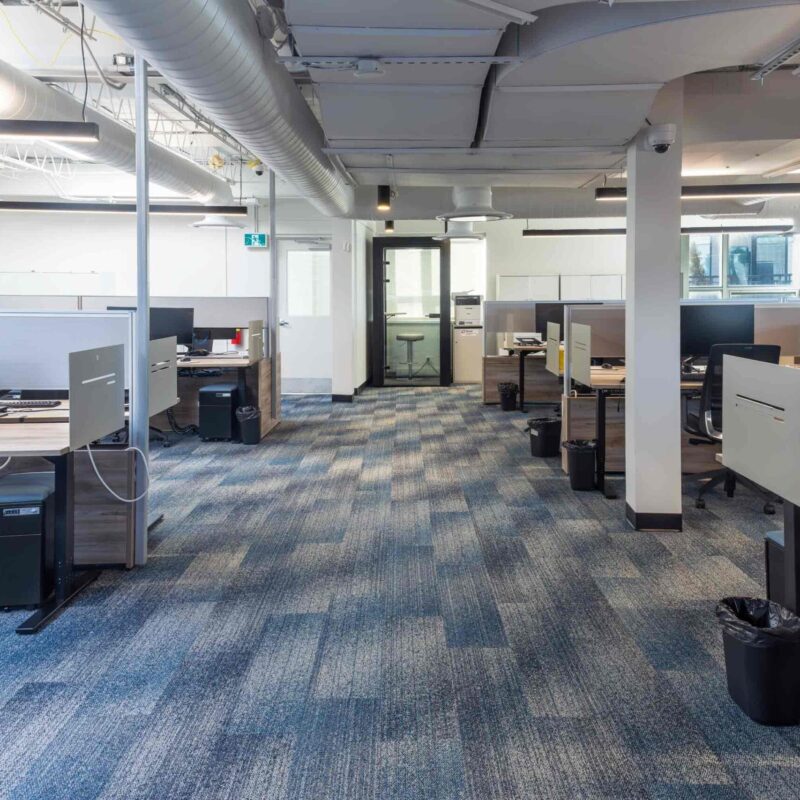
- Ergonomic workstations
- Advanced ventilation systems
- Safer circulation pathways
- Flexible collaboration areas
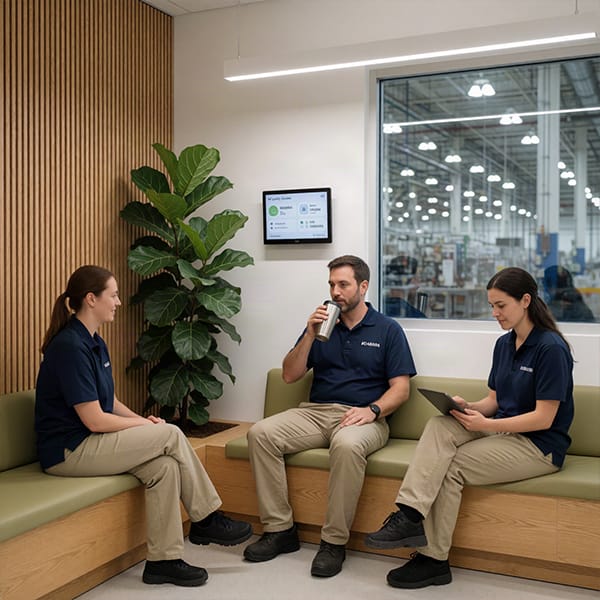
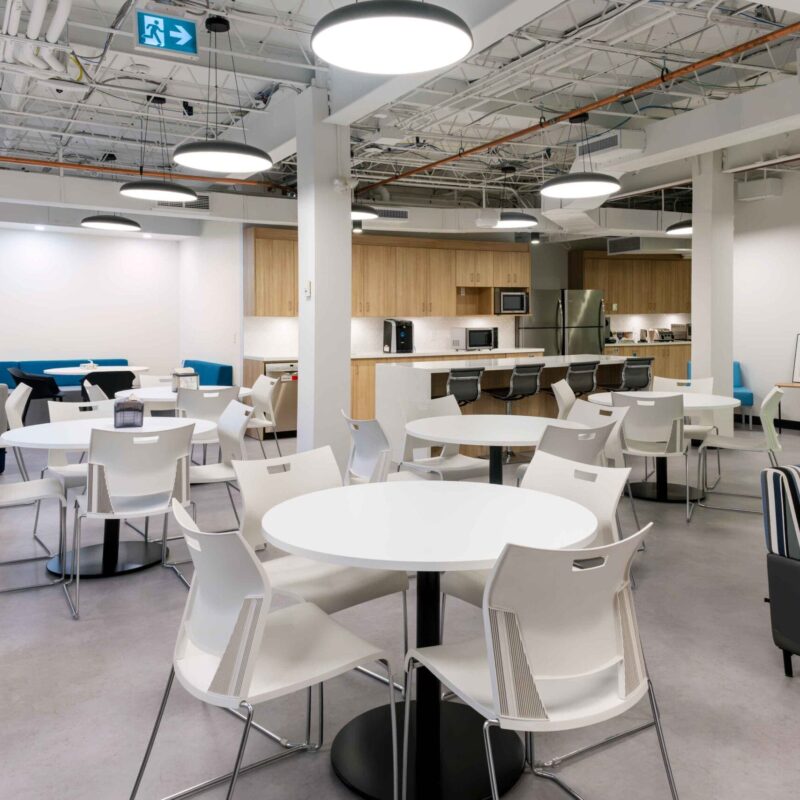
- Enhanced breakrooms and amenities
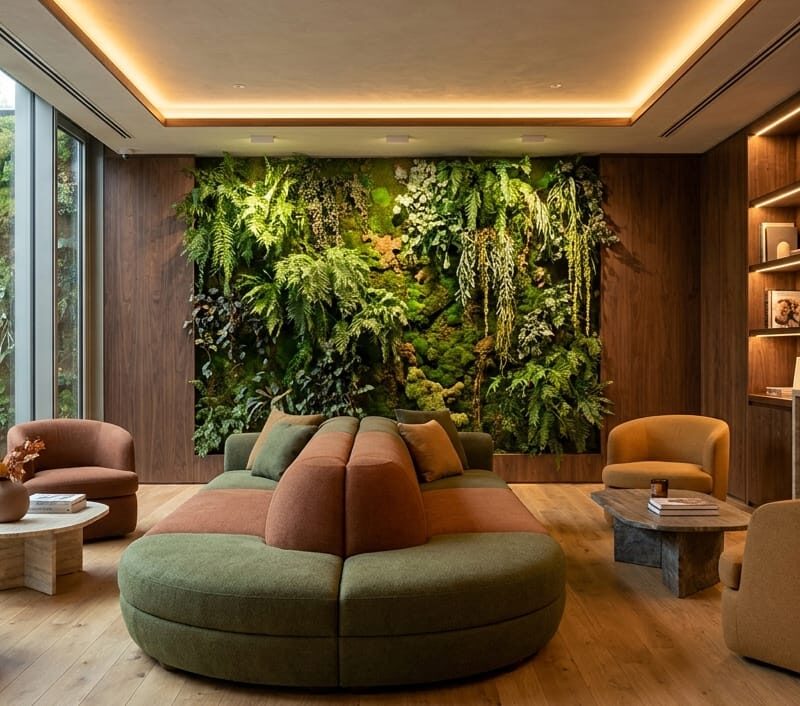
- Biophilic design elements
These features are no longer viewed as luxury upgrades. They are increasingly tied to compliance expectations, employee satisfaction, and long-term operational performance.
Indoor Air Quality and Healthier Buildings
Indoor air quality has become one of the most critical issues in modern workplace compliance. Following global health concerns and stricter environmental expectations, organizations are investing heavily in HVAC optimization, air filtration technologies, occupancy-based ventilation controls, and healthier building materials.
Many new commercial interiors are now designed around WELL, LEED, and BREEAM performance standards, integrating wellness and sustainability directly into building operations.
Sustainability Is Now Inseparable From Compliance
Environmental regulations are tightening across North America, while clients, investors, and tenants increasingly expect organizations to demonstrate measurable ESG performance. As a result, commercial and industrial design-build firms are prioritizing:
- Energy-efficient lighting systems
- Smart HVAC controls
- Low-VOC materials
- Recycled and responsibly sourced finishes
- Thermal performance optimization
- Smart energy monitoring
- Water efficiency systems
- Adaptive reuse strategies
What makes this shift particularly important is that sustainable design often reduces long-term operational costs while improving regulatory alignment. Energy-efficient facilities typically experience lower utility expenses, improved asset value, and stronger tenant attraction. Sustainability is therefore moving from branding exercise to operational necessity.
Technology-Enabled Safety and Compliance
Technology integration is another major trend reshaping safety and compliance management.
Modern commercial interiors are increasingly designed with embedded smart systems rather than standalone technology added after construction. Occupancy sensors, smart lighting controls, AI-driven monitoring platforms, integrated access systems, predictive maintenance tools, and environmental analytics are becoming standard components of future-ready facilities.
These technologies allow organizations to proactively manage risk instead of reacting to problems after they occur.
For example
- Occupancy analytics can improve emergency planning and circulation safety.
- Predictive maintenance systems can identify equipment failures before incidents occur.
- Smart environmental sensors can monitor air quality and thermal conditions in real time.
- AI-driven safety analytics can detect operational risks earlier.
- Access control systems improve both security and compliance documentation.
This transition toward data-driven safety management represents one of the most important evolutions in industrial facility planning.
Safety, Workflow Efficiency, and Industrial Operations
Another growing issue within industrial environments is the relationship between safety and workflow efficiency.
Poorly designed circulation patterns, congested staging zones, insufficient visibility, and inefficient storage systems can create hidden operational risks that increase accident potential and reduce productivity simultaneously. Industrial designers are therefore increasingly applying lean manufacturing principles and workflow optimization strategies directly into spatial planning.
Modern industrial interiors are prioritizing
- Clearer circulation systems
- Improved visibility lines
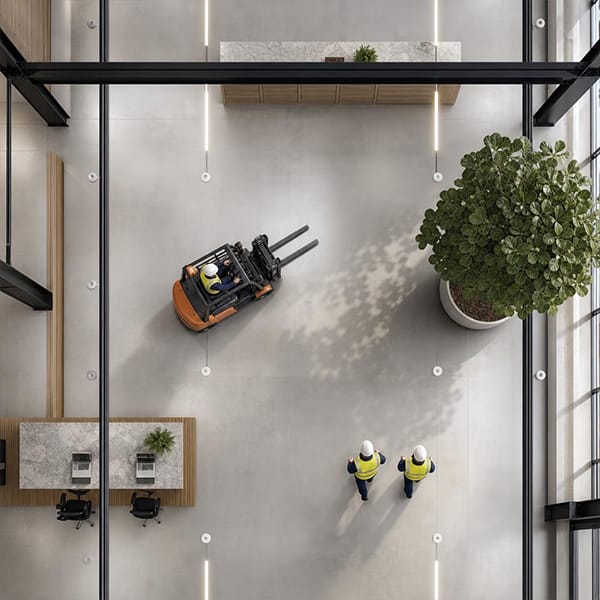
- Safer forklift and pedestrian separation
- Vertical storage optimization
- Reduced congestion points
- Enhanced wayfinding
- Better zoning logic
- Flexible operational pathways
These changes improve both compliance and operational performance simultaneously.
Accessibility and Universal Design
Accessibility compliance is also evolving rapidly.
Commercial and industrial facilities are increasingly being designed with broader inclusion strategies that go beyond minimum code requirements. Universal design principles now influence workplace layouts, circulation systems, furniture selection, collaborative spaces, washroom design, and technology integration.
Organizations recognize that accessible environments improve employee experience, talent attraction, operational flexibility, and long-term usability. More importantly, designing inclusively from the beginning is significantly more cost-effective than retrofitting facilities later.
Adaptive Reuse and Retrofit Optimization
Adaptive reuse and retrofit optimization are becoming increasingly important solutions for organizations seeking to modernize aging facilities without full reconstruction.
Rather than demolishing existing industrial or commercial buildings, many organizations are investing in strategic retrofits that improve safety systems, sustainability performance, accessibility, and operational efficiency while preserving existing infrastructure.
This approach is particularly valuable in urban industrial markets where construction costs and real estate prices continue to rise. Smart retrofits allow organizations to modernize facilities more affordably while maintaining operational continuity.
The Role of the Design-Build Delivery Model
Importantly, the design-build delivery model itself is becoming a critical factor in successful compliance management.
Traditional project delivery often separates architects, engineers, contractors, compliance consultants, and operational stakeholders into disconnected silos. This fragmentation frequently creates communication gaps, change orders, redesigns, delays, and expensive compliance conflicts during construction.
Integrated design-build strategies reduce those inefficiencies by aligning all disciplines early in the project lifecycle. Safety and compliance considerations become embedded into the design strategy from the start instead of appearing later as operational obstacles.
This collaborative model improves
- Budget predictability
- Construction coordination
- Risk management
- Schedule efficiency
- Operational continuity
- Long-term adaptability
The Bottom Line
As regulations continue evolving and workforce expectations rise, organizations are beginning to understand that safety and compliance are not barriers to innovation — they are drivers of smarter, higher-performing environments.
The most successful commercial and industrial facilities of the future will not simply meet code requirements. They will integrate safety, sustainability, wellness, technology, and operational performance into one cohesive strategy.
Safety and compliance essentials are no longer about minimum standards.
They are about creating resilient environments that protect people, support productivity, strengthen operational performance, improve employee experience, and future-proof business operations in an increasingly complex world.